Your client was pushed off the property last month. Or the tenant's lease ended in March and they simply never left. Either way you're filing an ejectment case — and the first decision you make is the one most likely to sink it.
Forcible entry and unlawful detainer are both summary ejectment actions under Rule 70 of the Rules of Civil Procedure, now conducted under the 2022 Rules on Expedited Procedures in the First Level Courts (A.M. No. 08-8-7-SC, effective 11 April 2022, prospectively). Both belong to the first-level courts — MeTC, MTCC, MTC, MCTC — and, unlike most possessory suits, the property's assessed value does not matter. What matters is that you file within one year. They look interchangeable. They are not. Mislabeling the cause of action is the most common jurisdictional pitfall in possessory litigation — a complaint that mischaracterizes the action, or omits the jurisdictional averments, prevents the court from acquiring jurisdiction at all.
Here is the decision, in the order you actually have to make it.
1. The question that decides it: how did their possession begin?
Everything follows from the initial character of the defendant's possession.
Forcible entry — the defendant's possession was wrongful from the very start. You must be able to allege and prove two things: that your client had prior actual physical possession, and that they were deprived of it through force, intimidation, threat, strategy, or stealth. Those five means are the statutory list; if the dispossession doesn't fall within them, this isn't forcible entry.
Unlawful detainer — the defendant's entry was originally lawful: by contract, or by the plaintiff's mere tolerance. It became unlawful only later, when the right to possess expired or was terminated.
On demand: it is generally required, and in a tolerance case it is jurisdictional — plead it and prove it. But it is not required in every scenario: where the ground is simply that the lease expired by its own terms, prior demand is not a precondition to suit. Rule 70 also opens with "unless otherwise stipulated," so the contract itself can change the picture.
That single fact — lawful entry or not — sorts almost every case. Note the trap in the tolerance scenario: tolerance must have been present from the beginning of the possession. A complaint that pleads tolerance as an afterthought, to dress up what was really a forcible entry, is a familiar way to lose on jurisdiction (see Amada C. Zacarias v. Victoria Anacay, G.R. No. 202354).
2. The one-year clock — and it starts on a different date for each
Both actions must be filed within one year, but the clock does not start in the same place:
- Forcible entry: one year from the date of actual entry — except where entry was by stealth, in which case it runs from discovery of the entry.
- Unlawful detainer: one year from the last demand to vacate — but read that carefully. A later letter that merely repeats the original demand is treated as a reminder, not a fresh demand, and does not restart the clock; the period still runs from the original demand (Rivera-Avante v. Rivera, G.R. No. 224137, citing Racaza v. Gozum). Sending another demand letter does not revive an action that has already prescribed.
That difference is not a technicality. It routinely decides whether you are still in the first-level court or already out of it.
3. What the court can actually give you
What an ejectment court can award is deliberately narrow:
- restitution of the premises
- arrears of rent, or reasonable compensation for the use and occupation of the property
- attorney's fees and costs of suit
And nothing further — in particular, moral and exemplary damages are not recoverable in ejectment. "Damages" here means compensation for the use and occupation of the property, not the general civil-law sense. An ejectment court decides physical possession; it touches ownership only provisionally, and only when it must in order to resolve possession — its judgment binds possession only, never title. If your case is really about title, this is the wrong case.
One more thing worth telling the client early: the judgment is immediately executory. To stay execution pending appeal the defendant must do three things — perfect the appeal, file a supersedeas bond, and deposit the accruing rents or compensation periodically — on the dates the rent falls due under the contract, or, where there is no contract, on or before the tenth day of each succeeding month or period. Missing any one of the three is enough to lose the stay.
4. When it's neither
Miss the one year and you are out of Rule 70. The plenary action for the better right of possession is accion publiciana; if what you're really litigating is ownership, that's accion reivindicatoria, and a judgment on ownership carries possession with it.
Where those two go is a question of assessed value, not automatically the RTC. Under BP 129 as amended by RA 11576 (2021), the line sits at an assessed value of ₱400,000: above it, the Regional Trial Court; at or below it, the first-level courts. (RA 11576 applies prospectively, to cases filed from its effectivity in 2021 — older cases still run on the previous thresholds. The Supreme Court is also empowered to adjust these amounts, so check the figure is current when you file.)
There is a refinement worth knowing, because it cuts against the usual "wait out the year" instinct: accion publiciana is available not only where dispossession has lasted more than a year, but also where it has lasted one year or less in cases outside Rule 70 — that is, where there was no deprivation by force, intimidation, threat, strategy, or stealth (Spouses Noel M. Agullo, et al. v. Lea Victa-Espinosa, G.R. No. 269921, 22 April 2025, En Banc, clarifying Heirs of Cullado).
5. Now check it against the case law — in minutes, not an afternoon
Everything above is the settled framework. What actually decides your case is how the Supreme Court has applied it to facts like yours — and whether the case you're about to cite is still good law.
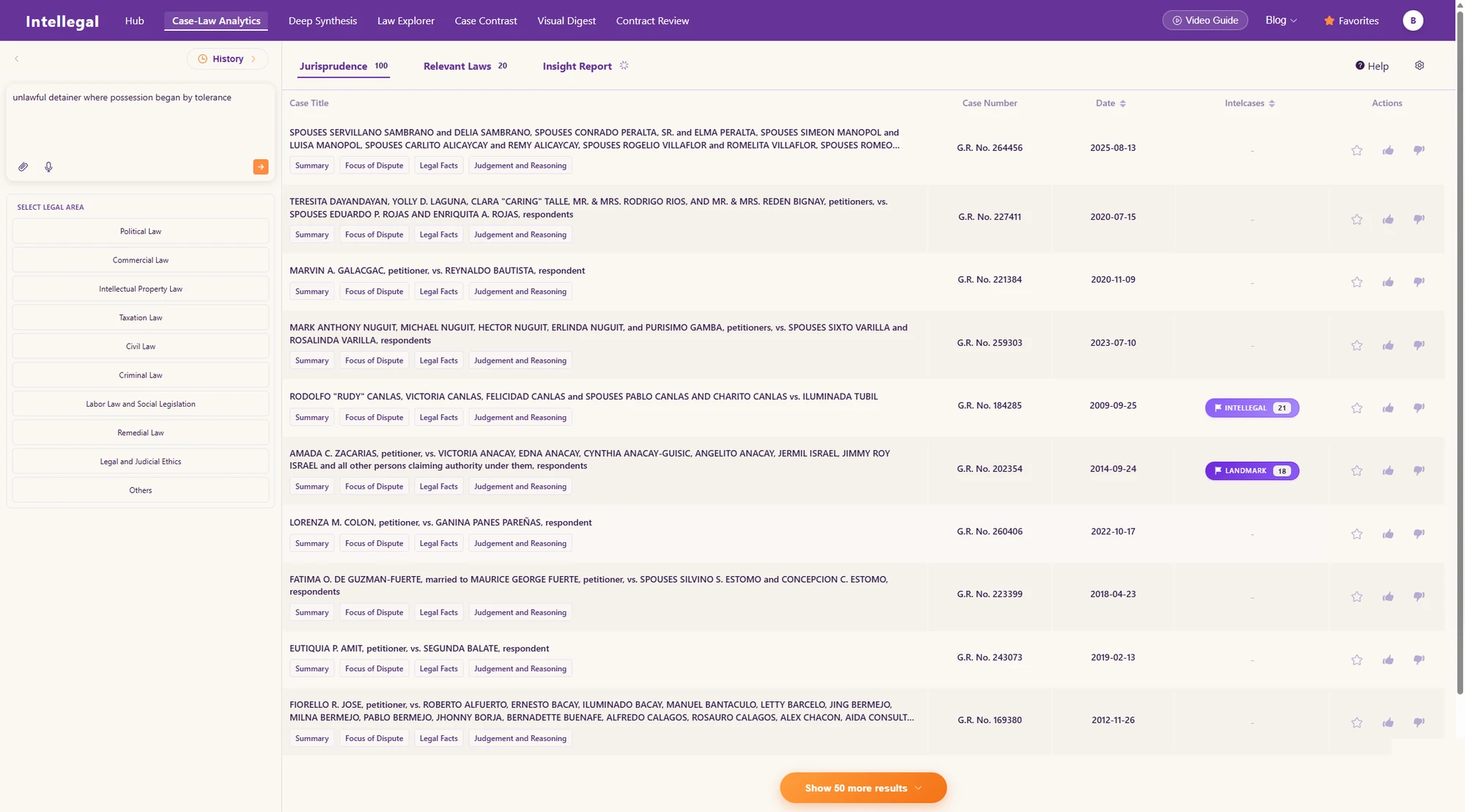
That's the part Case-Law Analytics is built for. Search the question the way you'd ask a colleague — "unlawful detainer where possession began by tolerance" — and you get the decisions on point, the provisions behind them, and an insight report, rather than a keyword list you still have to sift.
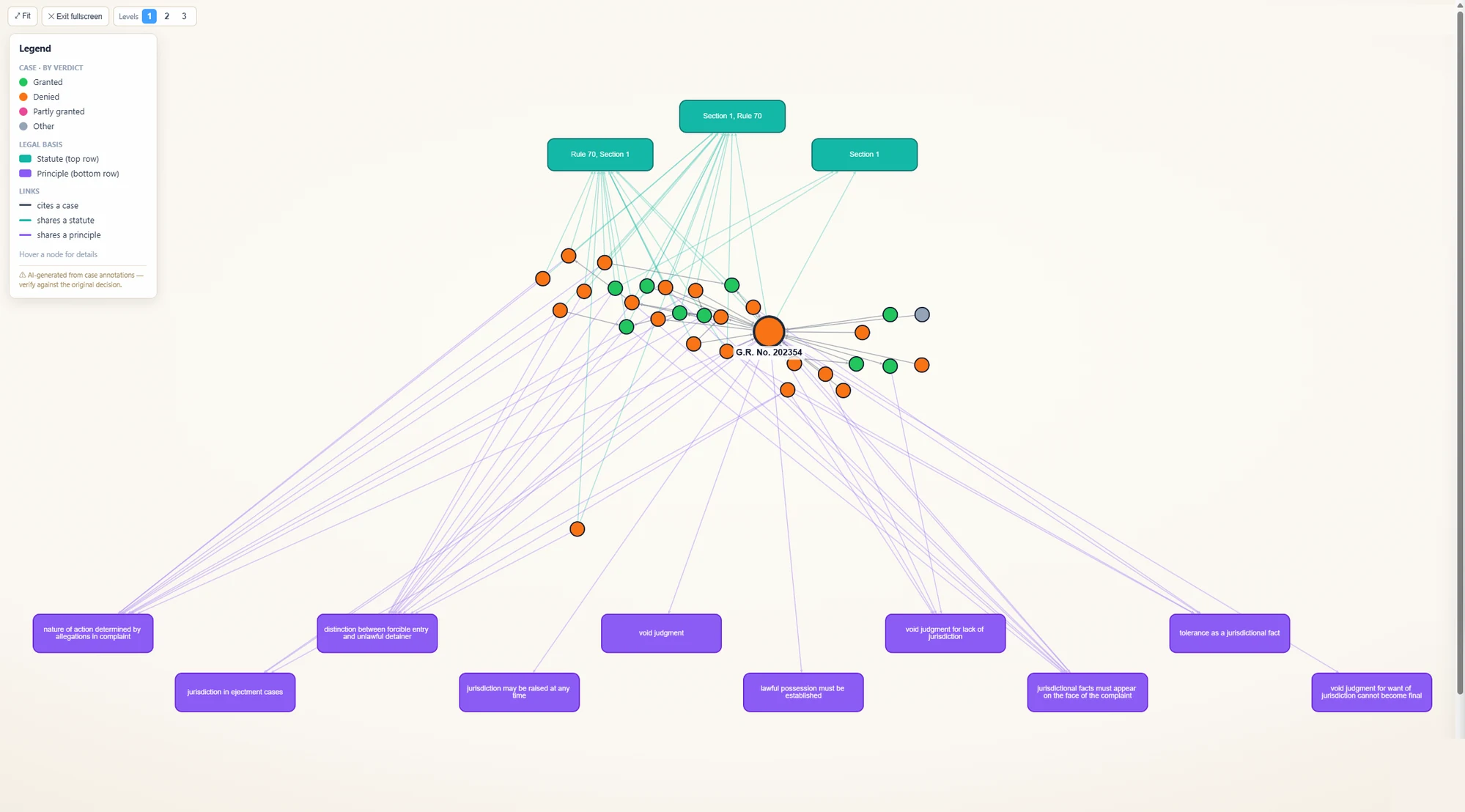
Then open any decision and use the Citation Map. It puts that ruling at the centre and draws out what it connects to: the cases around it, colour-coded by outcome; the statutes and rules it applies; the doctrines it turns on. The links tell you why two cases connect — one cites the other, or they share a statute, or they share a principle. For an ejectment case that is exactly the question you need answered: has this doctrine been followed, distinguished, or overtaken since?
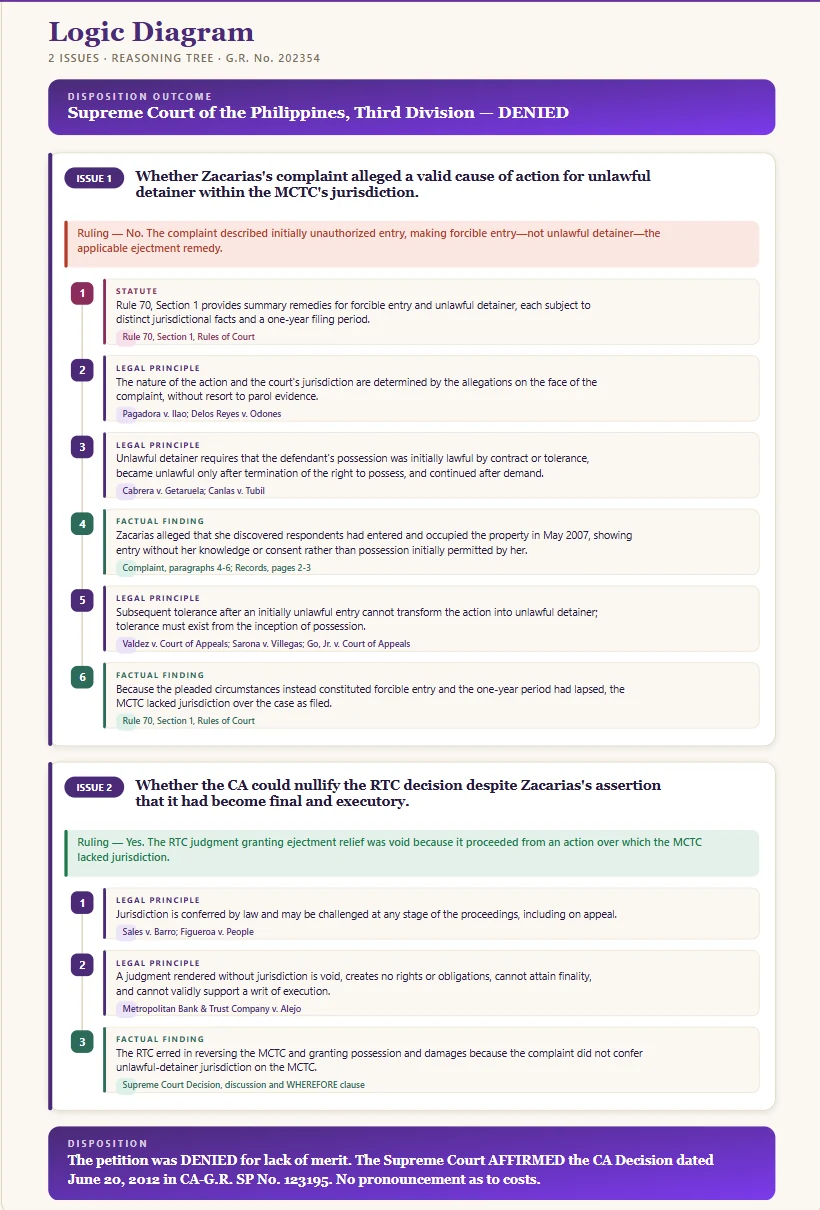
Visual Digest does the other half. Open a long decision and you get a plain-language summary, a timeline of what happened, and a diagram of the court's reasoning — the disposition, each issue, and the statutes, principles, and findings behind it. Useful when you need the shape of a case before deciding whether to read all forty pages.
Every case, statute, and doctrine on screen opens to its primary text. Nothing is a dead end — which is the point. You check it yourself; you don't take the tool's word for it.
Need the full treatment? The jurisdictional averments, the counting rules, the reliefs, and the leading decisions are collected on our research page: Forcible entry & unlawful detainer (Philippines).
Cases referenced above: Amada C. Zacarias v. Victoria Anacay, et al., G.R. No. 202354 (24 September 2014) · Leonora Rivera-Avante v. Milagros Rivera, G.R. No. 224137 (3 April 2019) · Spouses Noel M. Agullo, et al. v. Lea Victa-Espinosa, G.R. No. 269921 (22 April 2025, En Banc).
Check the authority before you file.
Open Case-Law Analytics →Intellegal is a legal research and review assistant developed by Technese Legaltech Inc. (Makati). It supports legal work and does not provide legal advice; verify all outputs against the primary sources it cites.